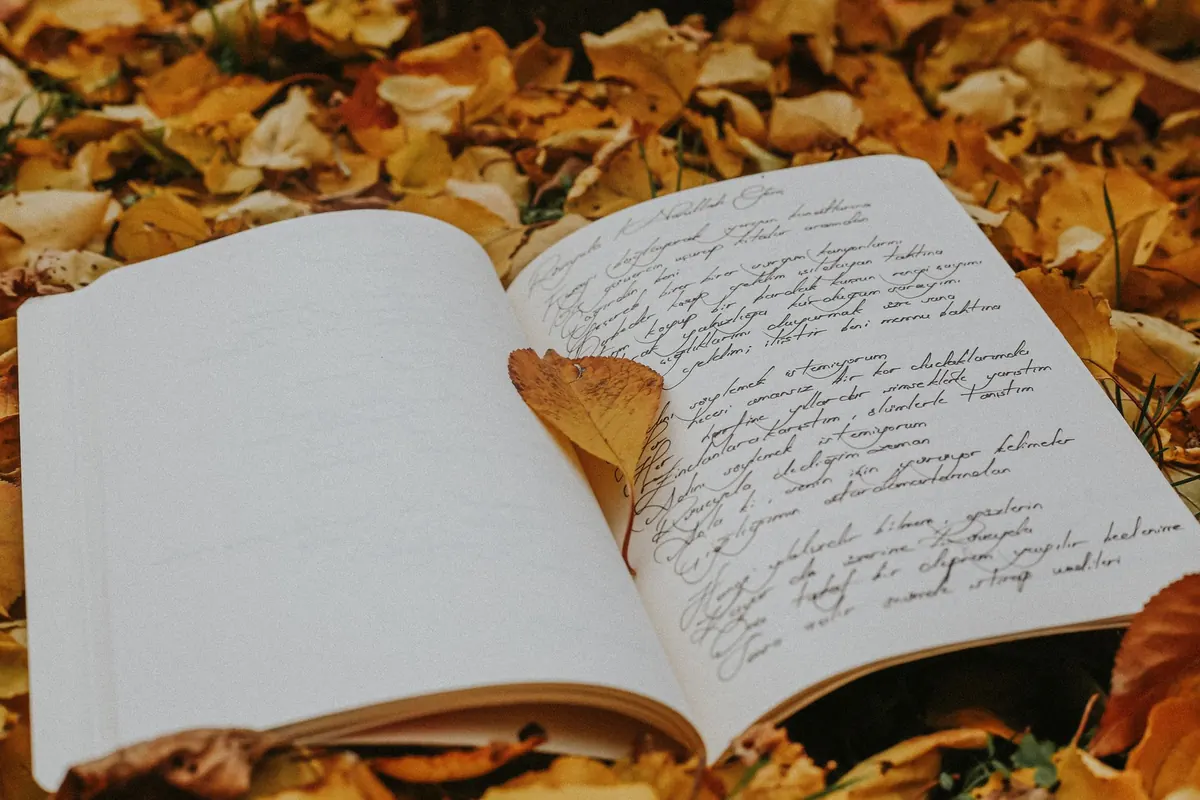
Autumn doesn't arrive all at once. There's the morning the air has an edge to it, the evening you close the curtains before six, the afternoon the light turns the colour of honey and you stop mid-step to notice. Then the clocks go back and it's dark by five, and the season has settled in properly.
The fifty prompts below follow that shift, from what's happening outside your window to what's happening underneath the surface. Work through them in order, pick the ones that pull at you, or copy three onto the inside cover of a notebook and leave the rest for another year.
Why Autumn Is a Natural Season for Journalling
Summer asks you to be out and doing. Autumn hands you raw material instead: weather that changes daily, hedgerows full of berries, light that turns early and gold, meals that move from salad to something slow in the oven. There's more to describe, and more reason to sit still with a notebook.
It also lands at a useful point in the year. The equinox splits light and dark evenly, harvest is gathered, school routines restart. You get a natural pause halfway through your plans, without the pressure of January.
50 Autumn Journal Prompts
Noticing the Season (1–10)
- Describe one tree you pass daily, as if to someone who has never seen it.
- What does your street smell like this week — woodsmoke, wet leaves, rain on warm pavement?
- Write down the exact moment the afternoon light turns golden. What time is it?
- Record the first morning you needed a coat. What did you wear?
- Take a hedgerow or park and list every berry, seed head and fungus you can name.
- What sounds belong to autumn where you live? Bin day, rain on a lid, geese, the boiler clicking on.
- Keep a weather diary for a week: temperature, sky, rain, wind. Facts only.
- What does your kitchen smell of in October? Write it while something's cooking.
- Name the precise shade that stops you — rust, ochre, oxblood — and where you saw it.
- What has changed on your walk to work or the school gate since August?
Memory and Nostalgia (11–20)
- What did autumn mean to you when you were nine?
- Write about an autumn coat or pair of school shoes you remember wearing.
- Choose one memory: conkers, bonfires, fireworks, a Halloween costume. Tell it plainly.
- Who did you walk to school with, and what did you talk about in October?
- Describe a childhood kitchen on a dark evening — the food, the noise, the people.
- What was your first autumn after leaving home like?
- Write about someone you'd like to sit with through one more autumn evening.
- Recall an autumn walk you've never forgotten. Where did it end?
- Which family traditions have you kept, dropped, or quietly changed?
- Write a short letter to your past self about the season they're walking into.
Home, Comfort and Cosiness (21–30)
- What makes a room feel warm without the heating on full blast? Be specific.
- Plan your ideal autumn Sunday, from waking up to lights out.
- Write your comfort meal of the season from memory, as a recipe.
- List five small things that make dark evenings feel like a gift.
- Which jumper or blanket do you reach for every year, and what's its history?
- What do you read in autumn? Name the book that suits a wet afternoon.
- How do you light your home in October? Candles, lamps, where each one sits.
- What would a genuinely restful evening this week look like, hour by hour?
- Describe the sound of rain against your window, from the inside.
- What's your honest relationship with the thermostat as it gets colder?
If heating bills or money worries are pressing on you, journalling can help you think clearly, but it isn't a plan. For proper guidance, speak to a qualified adviser — Citizens Advice is free and impartial.
Change, Letting Go and Beginnings (31–40)
- What are you ready to let fall away this season?
- The equinox balances light and dark. Where would you like more balance?
- Write about something you're holding onto past its season.
- What did you say yes to this year that you'd say no to now?
- Describe a change you resisted that turned out well.
- What does harvest mean for you this year — what did you grow and gather?
- Write about the version of yourself that's ending, without judgement.
- Which habit could you shed before the clocks go back?
- What are you carrying towards winter that you'd rather put down?
- Write three lines of permission: things you're allowed to stop doing.
Looking Ahead to Winter (41–50)
- What do you want finished by the shortest day?
- How will you look after yourself when the light drops?
- Describe the winter you'd like to have, in small domestic detail.
- What are your plans for the first dark evening after the clocks change?
- List five things to look forward to between November and February.
- What will you do on the year's darkest day?
- Who do you want to see more of, and how will you actually arrange it?
- Choose a winter project: something to make, learn or finish.
- What does rest look like for you, rather than what you think it should look like?
- Write a note to yourself to open in January. Seal it and date the envelope.
How to Use These Prompts Without Overthinking
- Set a ten-minute timer and stop when it rings, even mid-sentence. A short entry you actually write beats a long one you keep postponing.
- Match the prompt to your mood. Memory prompts suit a bright afternoon; letting-go prompts suit a wet Sunday.
- Write badly for three lines. It clears the way to the part you didn't know you were going to say.
- Date every entry. In a year, the timeline will matter more to you than the prose.
- Skip what doesn't fit. Fifty prompts is a menu, not a syllabus.
A Small Autumn Ritual That Sticks
Habits survive on friction, so remove some. Keep the notebook in the same place — beside the kettle, on the arm of your chair, in the bag you take to work. Use the same pen until it runs out.
Then attach the writing to something you already do. While the kettle boils. After the washing-up. On the bus home. Fifteen minutes is generous; five is enough on a bad day.
If you'd rather move first, take one prompt out on a walk and answer it in your head, then write the answer down when you're back. Three sentences will do: what I noticed, what I'm carrying, what I'm letting go of.
Keeping It Going Until the Clocks Change
Choose three prompts from this list now and write them on a sticky note inside the front cover. Aim to fill one page a week, not one a day. Gaps are fine; the notebook doesn't keep score.
And if the shorter days leave you persistently flat, tired or low, that's worth mentioning to your GP. Writing helps you pay attention, but it isn't a substitute for proper support when you need it.
Photo: betül nur akyürek / Pexels